How to reply to a recruiter on LinkedIn: 8 templates for every answer
What to say when a recruiter messages you on LinkedIn — interested, not right now, no thanks, or asking about salary — with 8 short reply templates.

Reply to a recruiter within a few days, even if the answer is no. Thank them, give your answer in the first sentence, and add one useful detail: what you are looking for, when you might be open, or the question you need answered (usually salary and location) before going further. Keep it under 80 words — recruiters read many messages a day.
Why it is worth replying, even when you are not interested
A recruiter who messaged you once will probably message you again — and the next role might be the right one. A two-line polite reply costs you a minute and keeps a useful contact warm. Ignoring the message costs nothing today but closes that door.
Three rules for every reply:
- Answer first. Interested, not now, or no — in the first sentence.
- Be specific about what you want. Role type, seniority, location or remote, salary range.
- Keep it short. Under 80 words. Details can come on a call.
If you are interested (3 templates)
Hi Sarah, thanks for reaching out — this sounds interesting. Could you share the salary range, whether the role is remote or hybrid, and the team size? If it's a fit, I'd be happy to set up a call this week.
Hi David, thank you for thinking of me. I'm open to hearing more. I'm free Tuesday or Thursday after 2 pm (GMT) for a 20-minute call — would either work? My CV is attached.
Hi Aisha, thanks for the message. I'm currently looking for senior frontend roles, fully remote, in the £70–80k range. If this matches, I'd love to know more; if not, please keep me in mind for something similar.
If now is not the right time (2 templates)
Hi Tom, thank you for reaching out. I'm happy in my current role and not looking right now, but I'd be glad to stay in touch — feel free to check back in six months.
Hi Lina, thanks for thinking of me. The timing isn't right for me, but a former colleague, Omar Khan, might be a great fit — would you like me to introduce you?
If the answer is no (2 templates)
Hi James, thank you for the message. This role isn't the right fit for me, but I appreciate you reaching out and wish you luck filling it.
Hi Rachel, thanks for getting in touch. I'm not considering a move in the near future, so I won't be the right person for new roles for a while. Best of luck with the search.
If you need the salary before anything else (1 template)
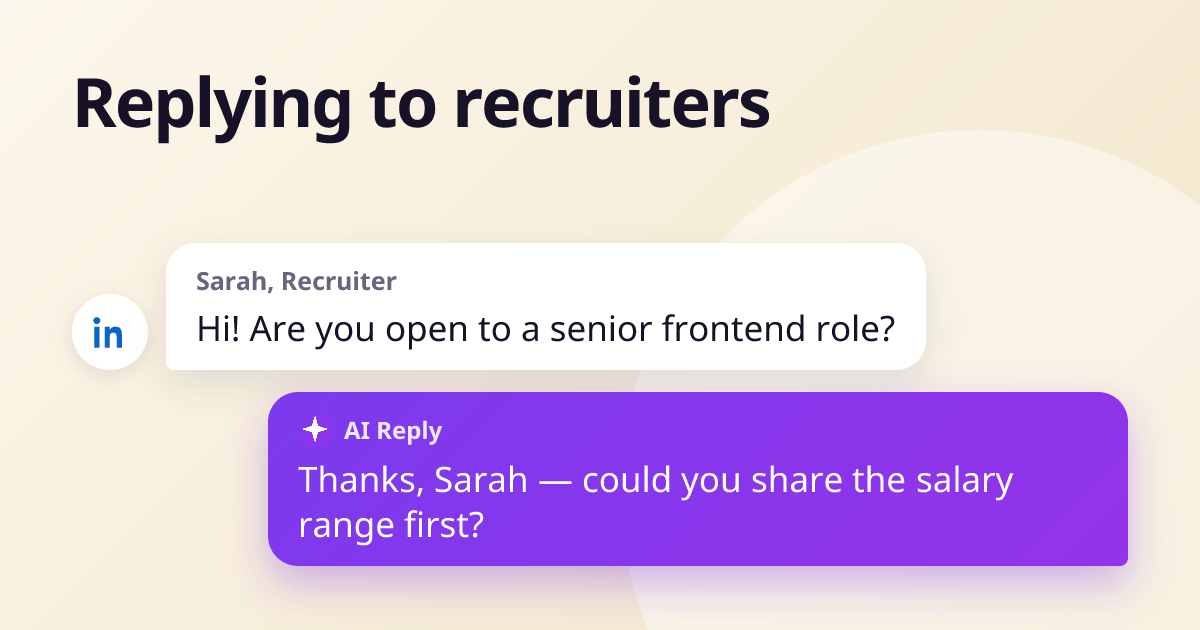
Hi Mark, thanks for reaching out. Before we set up a call, could you share the salary range for the role? It helps me make sure I don't waste your time.
Asking about pay up front is normal and saves both of you time. A recruiter who will not share any range at all is useful information too.
Common mistakes to avoid
- Replying weeks later — answer within a few days.
- Sending your whole life story — keep the detail for the call.
- Saying yes to a call without knowing the basics — ask about pay, location and level first.
- Copying the same reply to every recruiter — mention the role or company they wrote about.
Replying faster on LinkedIn
If recruiters message you often, AI Reply Writer can draft these replies inside LinkedIn's message box. It reads the recruiter's message, so the draft mentions the actual role, and you can tell it "interested but ask about salary" or "politely decline" in a few words. You review and send it yourself; nothing is sent automatically. The free plan includes 20 replies a month.
For other LinkedIn tools, see the best LinkedIn Chrome extensions, and for making any message clearer, polish this message.
Frequently asked questions
Should I reply to a recruiter on LinkedIn if I am not interested?
Yes. A short, polite reply keeps a useful contact, and the same recruiter may have a better role for you later. Two sentences are enough.
How soon should I reply to a recruiter?
Within a few days. A quick reply shows professionalism, and recruiters often fill roles quickly.
Is it OK to ask a recruiter about salary in the first message?
Yes. Asking for the salary range before a call is common and saves time for both of you.
How do I tell a recruiter I am happy in my current job?
Thank them, say you are happy in your current role and not looking right now, and invite them to check back in a few months if you want to keep the door open.