How to decline a meeting politely: 12 examples for email, calendar and chat
Polite ways to say no to a meeting invite — from your manager, a client, a colleague or a sales call — with 12 short examples and the alternatives to offer.

To decline a meeting politely, reply soon, thank the person, give a short honest reason, and offer an alternative: another time, a written update, or a colleague who is better placed. You do not need to over-explain or apologise at length. A one-line note with the decline in your calendar is enough for most internal meetings.
When it is fine to say no
Declining a meeting is not rude; leaving an invite unanswered, or accepting and not turning up, is. Good reasons to decline include:
- You are not needed to make the decision, and the notes would tell you everything.
- There is no agenda, so you cannot tell what the meeting is for.
- It clashes with work that has a deadline.
- Someone else on your team is closer to the topic.
- It is a sales call for something you are not buying.
The formula: thanks, reason, alternative
- Reply quickly. The organiser needs to know who is coming. A fast no is kinder than a late one.
- Thank them for including you.
- Give a short reason. One honest clause — "I'm on a deadline for the launch" — not a paragraph.
- Offer an alternative. A different time, an async update, or the right person to invite instead.
In Google Calendar and Outlook you can decline with a note attached, and both let you propose a new time instead of a flat no. For most internal meetings, that note is all you need.
12 examples
Colleagues and internal meetings
Thanks for the invite, Sara. I don't think I'm needed for this one — could you share the notes afterwards? If a decision touches the design, I'm happy to join for that part.
Hi Tom, I'm heads-down on the launch until Thursday, so I'll skip this one. Could we do 15 minutes on Friday morning instead?
Hi Priya, happy to help — could you share what you'd like to cover? If it's a quick question, I can probably answer it here and save us both the time.
Hi team, I'm going to step out of the weekly sync for now, since my part of the project has wrapped up. I'll keep reading the notes, and please pull me back in whenever you need me.
Thanks, Mark. Aisha leads our onboarding work and will be far more useful in this meeting than me — I've added her to the invite. I'll catch up with her afterwards.
Your manager
Hi Rachel, I'd like to join, but I'm also due to finish the client report today. Which is the bigger priority? If the report can move to tomorrow, I'll be there.
Hi David, I can't make Tuesday's check-in, but I'll send a written update by noon covering progress, blockers and next steps. Happy to talk through anything in it after.
Clients and partners
Hi Emma, thank you for setting this up. Unfortunately I'm travelling on Wednesday. Would Thursday at 10 or Friday at 2 work instead? I'll keep both open until I hear from you.
Hi Lucas, thanks for the invite. I think we'll get more from a call once the first draft is ready next week — could we plan for then? I'll send the draft the day before so you can look at it first.
Sales calls and requests from strangers
Hi Jordan, thanks for reaching out. We're not looking at new tools in this area right now, so I'll pass on the call. Best of luck with the launch.
Hi Lena, thank you for the invitation. The timing doesn't work this quarter, but feel free to check back in January when we review our budget.
Hi Sam, thanks for thinking of me. I can't take on calls at the moment, but if you send me your two most important questions by email, I'll answer them this week.
Phrases to use, and phrases to skip
Useful: "I won't be able to join", "I'll pass on this one", "Could you share the notes?", "Would another time work?", "I've added the right person."
Skip: long apologies, invented excuses, and "I'm too busy" on its own — it reads as "you are not a priority". Give the real reason in a few words, or none: "I can't make it, but here's an alternative" is perfectly polite.
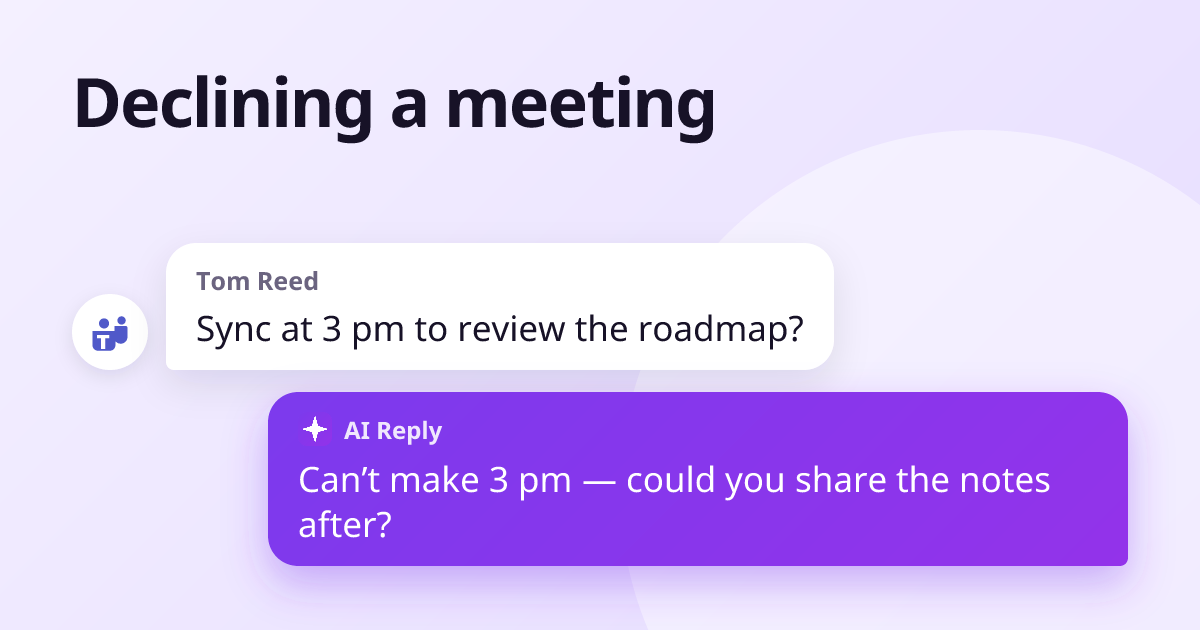
In Slack or Teams, the same rules apply but shorter: "Can't make the 3pm — I'll read the notes and follow up here" is enough.
Saying no faster
Declining well takes longer than accepting badly, which is why so many invites end in a silent "Maybe". AI Reply Writer drafts the reply for you in Gmail, Outlook, Slack and Microsoft Teams: press ✦ AI Reply, type "decline politely, suggest Friday", and it writes the message from the invite you have open. You edit it and send it yourself. The free plan includes 20 replies a month.
If a reply still sounds stiff, see polish this message for before-and-after examples.
Frequently asked questions
How do you politely decline a meeting invitation?
Reply quickly, thank the organiser, give a short reason, and offer an alternative such as another time, a written update, or a colleague who can attend instead.
Do I need to give a reason for declining a meeting?
A short reason helps, but you do not need to explain in detail. "I can't make it, but could you share the notes?" is polite and complete.
How do I decline a meeting with my boss?
Explain the conflict and ask them to help prioritise, or offer a written update instead. Managers usually prefer a clear trade-off to a silent no.
Is it rude to decline a meeting without a message?
For large meetings, a plain decline is usually fine. For small meetings, or when the organiser expects you, add a one-line note so they know why and what to expect instead.